
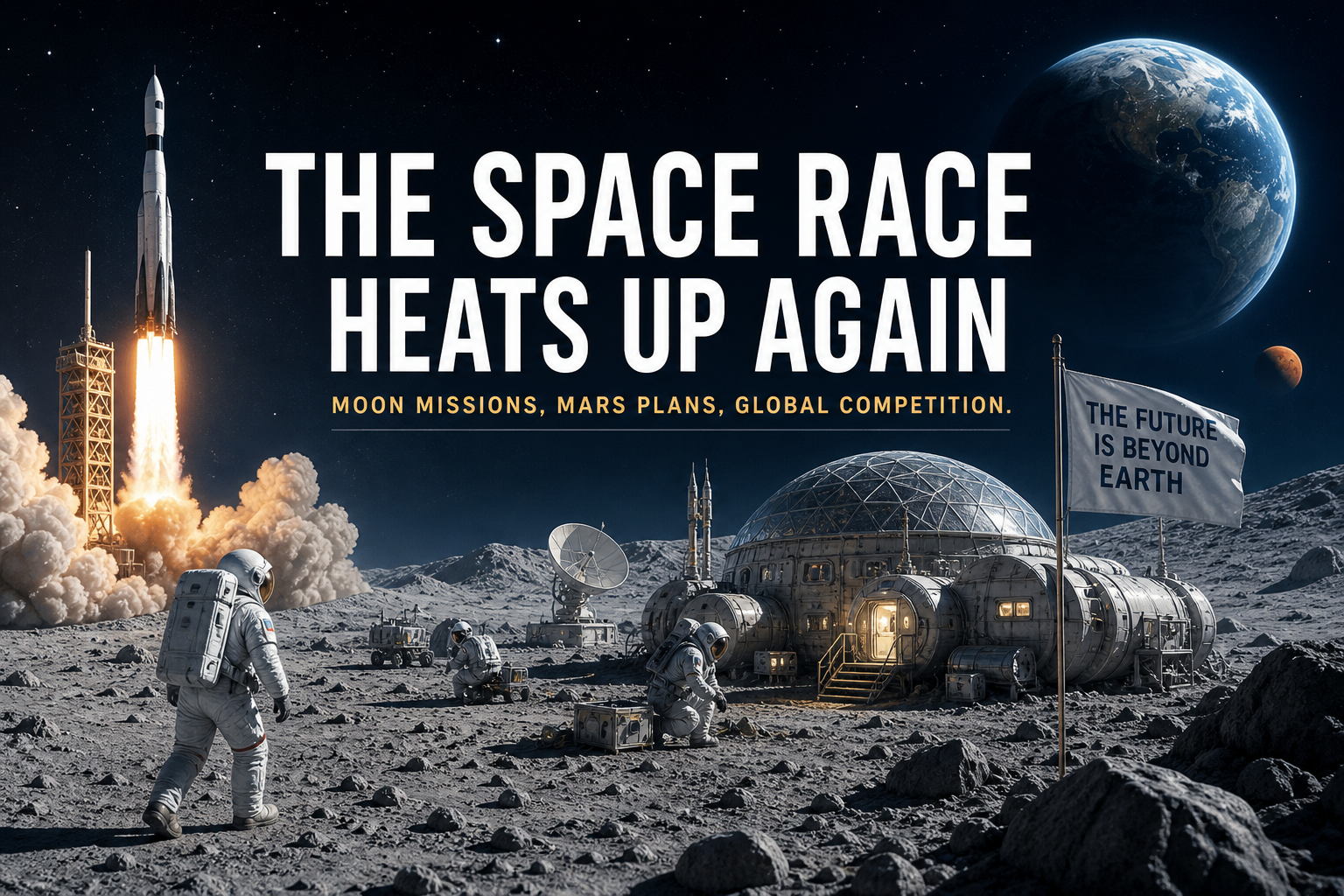
The global space race has entered a new and highly competitive phase in 2026, driven by a mix of national ambition, technological advancement, and private sector innovation. Once defined by Cold War rivalry, space exploration is now a complex and multi-player contest involving governments, billion-dollar corporations, and emerging space nations. The focus is no longer just on reaching space, but on staying there, building infrastructure, and ultimately expanding human presence beyond Earth.
Across the world, major powers are accelerating their space programs, setting ambitious timelines for lunar missions, Mars exploration, and orbital development. What was once a symbolic race has now evolved into a strategic and economic priority, with long-term implications for science, defense, and global influence.
Space Race 2026: A New Era of Lunar Missions


The Moon has become the central focus of this renewed space race. Unlike earlier missions in the 20th century, today’s lunar efforts aim to establish a sustained human presence. The NASA Artemis program is at the forefront of this initiative, with plans to return astronauts to the Moon and build a long-term lunar base.
The Artemis missions are designed not only to land humans on the Moon again but to develop infrastructure such as the Lunar Gateway, a space station orbiting the Moon that will serve as a staging point for future exploration. This approach reflects a shift from short-term missions to permanent operations.
Meanwhile, China is advancing its own lunar ambitions, aiming to construct a research station on the Moon in collaboration with international partners. China’s rapid progress in space technology, including robotic missions and space station development, has positioned it as a major competitor in the global race.
These parallel efforts signal a clear change in strategy. The Moon is no longer just a destination; it is becoming a base for deeper space exploration.
Space Race 2026 and the Push Toward Mars


Beyond the Moon, Mars remains the ultimate goal for many space agencies. The challenges of reaching and sustaining life on Mars are immense, but progress is accelerating. Long-duration space travel, radiation protection, and life support systems are being tested and refined through current missions.
Private companies are playing a crucial role in this effort. SpaceX, led by Elon Musk, continues to develop spacecraft capable of carrying humans to Mars. The company’s vision includes building a self-sustaining colony, a concept that was once considered science fiction but is now being taken seriously by industry experts.
Government agencies are also exploring Mars through robotic missions, collecting data that will inform future human exploration. These missions provide critical insights into the planet’s environment, resources, and potential for supporting life.
While a human mission to Mars may still be years away, the groundwork is being laid today through coordinated global efforts.
The Space Race 2026 is no longer limited to government agencies, as private companies play a major role.
Private Companies Reshaping Space Exploration


One of the most significant developments in the modern space race is the rise of private companies. Unlike the government-dominated efforts of the past, today’s space industry includes powerful commercial players that are driving innovation and reducing costs.
Companies such as Blue Origin and SpaceX are competing to develop reusable rockets, advanced spacecraft, and commercial space services. Reusability has dramatically lowered the cost of launching payloads into orbit, making space more accessible than ever before.
This shift has also opened the door to new opportunities, including space tourism, satellite deployment, and even plans for space-based manufacturing. Governments are increasingly partnering with private firms, recognizing that collaboration can accelerate progress and expand capabilities.
The involvement of the private sector has transformed space exploration into a dynamic and competitive industry, where innovation moves at a much faster pace.
Strategic and Economic Importance of Space


The renewed space race is not just about exploration; it is also about strategic advantage and economic potential. Satellites play a critical role in communication, navigation, weather forecasting, and national security. As a result, space has become an essential domain for global infrastructure.
Countries are investing heavily in satellite networks and space-based technologies to strengthen their capabilities. Control over space assets can influence everything from global communications to defense systems.
In addition, the concept of a “space economy” is gaining traction. This includes industries such as asteroid mining, space tourism, and orbital manufacturing. While many of these ideas are still in early stages, they represent significant long-term opportunities.
The economic value of space activities is expected to grow rapidly in the coming decades, making it a key area of competition among nations and corporations.
Challenges and Risks Ahead
Despite the excitement surrounding space exploration, significant challenges remain. The cost of missions, technical complexity, and safety concerns continue to pose obstacles. Human spaceflight, in particular, carries inherent risks that require careful planning and advanced technology.
There are also growing concerns about space debris, which can threaten satellites and spacecraft. As more objects are launched into orbit, managing space traffic becomes increasingly important.
Another issue is the lack of clear international regulations governing space activities. As more players enter the field, the need for cooperation and rules becomes more urgent to prevent conflict and ensure sustainable use of space.
These challenges highlight the importance of global collaboration, even in a competitive environment.
As the Space Race 2026 continues to evolve, global competition will shape the future of humanity beyond Earth.
Conclusion: A Defining Moment for Humanity
The space race of 2026 represents a turning point in human history. What was once a competition between two superpowers has evolved into a global effort involving multiple nations and private companies. The goals have expanded from symbolic achievements to long-term presence and economic development.
As technology continues to advance, the possibilities for exploration are growing. The Moon may soon host permanent bases, and Mars could become the next frontier for human settlement. At the same time, space is becoming an increasingly important part of life on Earth, influencing communication, security, and economic growth.
The coming years will determine how this new space race unfolds. Whether driven by competition or cooperation, one thing is clear: humanity is entering a new era of exploration, and the impact will be felt for generations to come.
Base on the strong sources:
Read my previous Ai Technology: https://todaynews21.com/ai-revolution-2026-impact-daily-life/”